
Editorial
For over thirty years, IRCAD has constantly evolved to advance surgery worldwide, supported by the deep commitment of the women and men who bring the Institute to life day after day, as demonstrated by the developments presented in this new newsletter. In Strasbourg, as in every international Institute, passionate teams organize, train, support, develop, and experiment. They concretely carry out our missions: training thousands of surgeons every year, maintaining an internationally recognized level of excellence, developing innovative solutions, and integrating constantly transforming technologies.
This daily commitment is all the more remarkable because our model is highly demanding. At IRCAD, nothing is frozen; everything is in motion. And this movement relies on the teams’ ability to understand, anticipate, and develop complex innovations to transform them into concrete and useful solutions, for the ultimate benefit of patients. We must permanently adapt to keep pace with rapid technological advances and to work with multiple stakeholders: clinicians, researchers, institutions, industry partners, and more.
This agile dynamic also enables IRCAD to be fully active on a global scale, with mirror Institutes that maintain the same coherence despite geographic distances and very different cultural contexts.
Finally, this collective commitment is part of a history built on encounters, convictions, occasional risk-taking, but above all, loyalty to a vision.
In this regard, I would like to pay a special tribute to Professor Didier Mutter, who was an essential player in building IRCAD from the very beginning. Along with him and Professor Michel Vix, we shared the same ambition: to transform surgery by creating a place where innovation and training would be inseparable. Didier Mutter supported this adventure with a scientific rigor and humanity that deeply marked our organization. His vision, commitment, and sense of community were decisive factors in IRCAD’s development. His passing leaves a great void, but his footprint remains in our values and in the spirit that guides our actions.
Professor Jacques Marescaux
Interview of the month
IRCAD: Continuous development to transform surgery worldwide

President and Founder of IRCAD
Professor Marescaux, since its creation in 1994, IRCAD has never ceased to innovate and evolve. What are the major developments of the past five years?
Pr. Jacques Marescaux:
Pr. Jacques Marescaux: Recent years have been marked by the acceleration of two major dynamics, artificial intelligence (AI) and robotic surgery, with a convergence that is profoundly changing surgery.
First, in terms of early diagnosis, because thanks to AI, we are entering an era where lesions can be detected at an ultra-early stage, sometimes even before they are visible to the clinician. This is particularly true in gastroenterology, where endoscopy systems coupled with AI make it possible to identify colon or rectum lesions with remarkable accuracy. The direct consequence is a shift in the surgical procedure itself: the earlier the detection, the less invasive the procedure needs to be. It is no longer always necessary to remove the organ; the lesion can be treated locally, sometimes even without an incision. In this context, endoluminal surgery, which goes through natural orifices (mouth, vagina, anus…), is now coming into its own. Back in the 2000s, IRCAD was a pioneer in this field with the launch of the NOTES program (Natural Orifice Translumenal Endoscopic Surgery, without external scars), exploring the major technical constraints of the endoluminal approach, such as the lack of operating space or the difficulty of navigating inside the anatomy. Conducted in continuity with NOTES, which is seeing real interest today in the vaginal approach for instance, technological advances have enabled the development of endoluminal robots that now lift these constraints and allow complex procedures to be performed through natural pathways with a very high level of precision and safety.
Another transformation is the integration of AI into medical imaging, which offers the ability to reconstruct a 3D image of the organ and all its vascular structures in real time from a conventional 2D ultrasound. AI thus guides the therapeutic gesture with unprecedented precision, taking into account any potential movements of the organ, such as those caused by breathing, which conventional imaging could not always track. It has thus become possible to destroy liver or kidney tumors through thermoablation (applying intense heat or cold to the center of the tumor) thanks to millimetric 3D guidance, avoiding partial or total organ resection. The next step is the integration of robotics into this process, with the development of robotic systems featuring one arm holding the ultrasound probe and another arm guiding the instrument toward the center of the tumor. The robot “understands” the tumor’s position in real time and can adjust the motion at any moment. IRCAD is conducting a vast research program in this area, the DISRUMPERE project.
Telesurgery is another major development, capable of radically transforming the management of public health challenges such as the treatment of ischemic strokes. Today, less than 3% of the world’s population has access to proper stroke treatment, which is all the more unacceptable given that this is not a technological problem but a lack of human resources. This situation is unsolvable because it is impossible to train enough neuroradiologists and neurosurgeons. The solution can only come from creating a global network of “control towers” in reference centers, mobilizing one or two specialists on a rotating basis. The first procedure took place two months ago, remotely piloted by a neurosurgeon from a hospital in Panama City to another hospital equipped with suitable robotic gear. This is a major breakthrough in terms of equitable access to care.
In terms of training development, how do you define priorities? For instance, how do you decide to integrate new courses or, conversely, phase others out, and how do you select the technological equipment needed for these training sessions?
Pr. J.M.: We are permanently connected to technological developments and field needs through a continuous exchange with clinicians, researchers, international corporations, start-ups, and more. This allows us to very quickly identify emerging trends, continuously verify what remains relevant or what is no longer useful, and adapt our training programs accordingly.
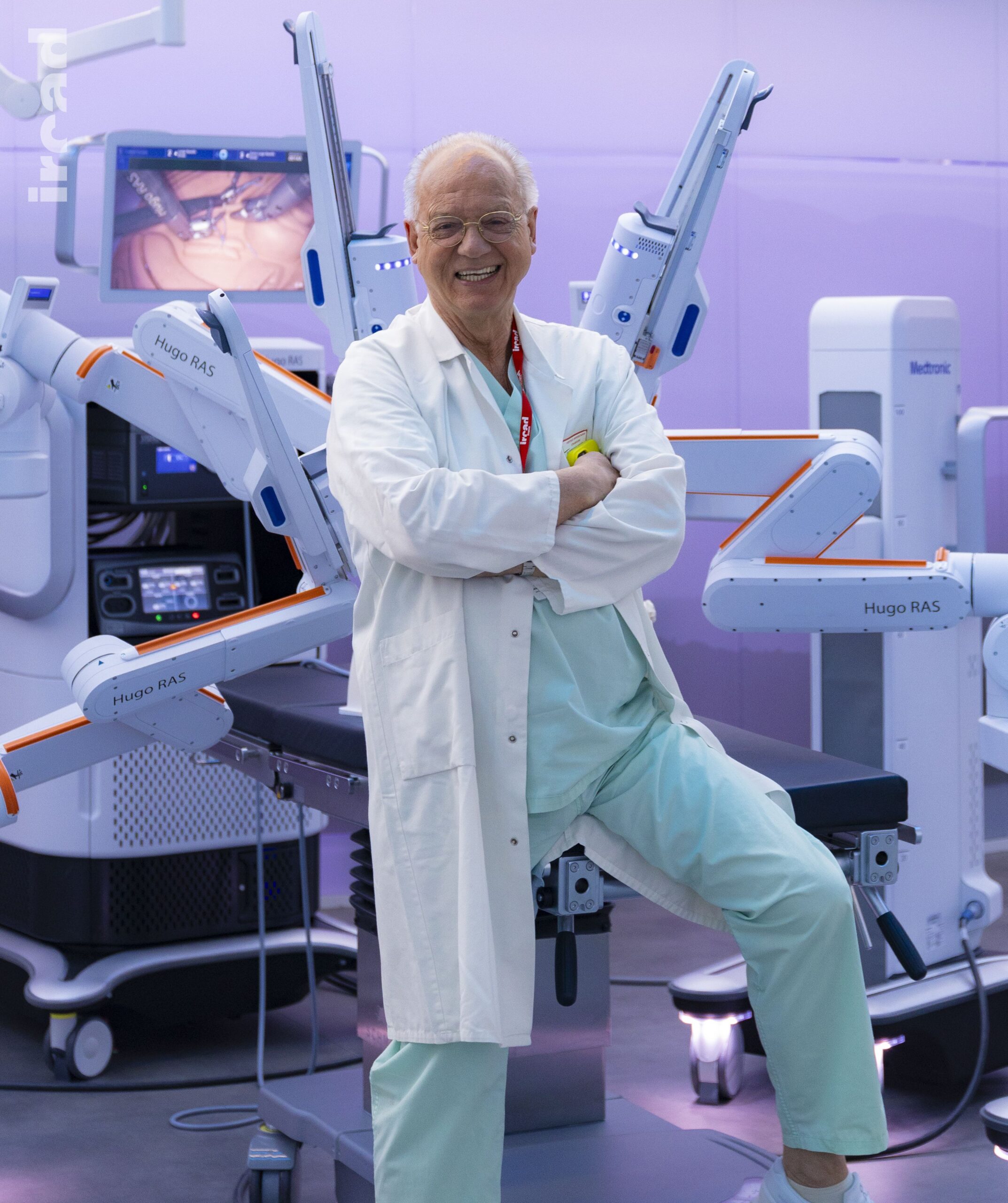
We have a network of several hundred internationally renowned expert trainers, and we are capable, for instance, of mobilizing around thirty of them for a single course session—something no traditional academic model can achieve. We also have a robotic platform unique in the world, including 42 robots on the Strasbourg site representing all existing brands, which provides a comprehensive overview of available technologies.
Since our training programs are internationally recognized for their high level of quality, industrial partners want to work with us to ensure that users of their new technologies are as well-trained as possible, preventing misuse. Project leaders, such as start-ups or clinicians, also approach us to help develop their ideas and/or ensure large-scale technology transfer. On a personal note, I participated in over 300 meetings at IRCAD France in 2025, either on-site or via videoconference.
Our responsibility is to select technologies showing real potential benefit for patients, through the right alignment between technological evolution and clinical need.
Take the example of cardiac surgery, which was initially a primary target for robotization. Unfortunately, the occurrence of significant complications quickly led to the discontinuation of robotic surgery in cardiology. However, 25 years later, technologies have advanced tremendously, and highly promising new robotic approaches are emerging, particularly in treating heart valves. We also recently welcomed a surgeon who performs cardiac procedures using an extremely innovative peri-areolar incision technique (around the nipple). Upon seeing our various robot systems, he immediately identified the potential of some of them to advance his technique. A new cycle is therefore beginning, and we have decided to relaunch robotic training in cardiac surgery in 2027.
As another example, we met with a company specialized in ultra-microsurgery, which allows for anastomoses between lymphatic vessels and veins. They are currently conducting a clinical trial in the United States for the treatment of Alzheimer’s disease, and we are following this closely.
International expansion very quickly became a pillar of IRCAD’s development. Can you tell us about the IRCAD International network, specifically how you define geographical priorities?
Pr. J.M.: IRCAD’s international development is based on a model driven not by a planned expansion logic, but by the appeal of the projects proposed to us.
Every month, we receive several requests to open facilities abroad, and selection relies on one fundamental criterion: the quality of the local team and the personality of its leader. When you meet a solid, committed team with a true vision, you know it can work. This model has enabled the creation of 8 mirror Institutes of IRCAD France, all attached to major hospital structures, which fosters training, research, and innovation activities.
We are proud of the reputation today associated with the IRCAD name. It serves as a guarantee of credibility and visibility on a global scale and makes our network strong. It is a powerful driver of attractiveness, facilitating partnerships and accelerating project development.
For example, in the United States, our latest Institute is partnered with Advocate Health, which is the leading group in the private hospital sector (71 hospitals). This group was keen to create its research and training center under the IRCAD name to ensure the rapid mobilization of the entire health innovation ecosystem (experts, researchers, industrial partners…). Recently inaugurated, IRCAD North America already has about fifteen robots, a nearly completed telesurgery center, and a fully booked course schedule. It is crucial to understand that developing innovative solutions is impossible without industrial partnerships; everything moves very fast, and surgical robotics is highly expensive. Equipment must be upgraded every 2 to 3 years, which can run into tens of millions of euros. No research center, not even the largest university, can fund this alone.
In terms of new locations, our most advanced project is located in Saudi Arabia, with the ambition to create not just an IRCAD but a true biocluster dedicated to innovation and technology transfer.
In parallel, we are conducting several structuring projects within existing locations. In Asia, the first stone of a 5,000m² extension dedicated to surgical robotics has just been laid at IRCAD Taiwan under the high patronage of the President of the Republic, who made it a national priority. An extension project is also underway at IRCAD America Latina in Brazil, where telesurgery was declared a national priority following meetings with the President of the Republic and the Ministers of Health, Research, Economy, and Telecommunications.
The governance of this global network relies on a subtle balance between high standards and adaptation, as each Institute evolves within a specific context, particularly regarding culture. This diversity is a challenge but also an asset that strengthens the overall innovation capacity of the IRCAD network, featuring a highly collaborative approach among the different Institutes worldwide.
After more than thirty years of existence, how do you view the place IRCAD holds today in the healthcare world, particularly on an institutional level, and how do you see your role continuing to evolve?
Pr. J.M.: Initially, our Institute operated rather on the fringes of the institutional world, whereas today, the situation has completely changed. Over time, we have developed numerous relationships with learned societies and other institutional players, both in France and globally. For example, we are a major player in the training of gastroenterological surgeons, with course programs designed both for the French Society of Digestive Endoscopy (SFED) and for European and world learned societies.
We are also heavily involved in the Society of Robotic Surgery (SRS), and we are currently creating the French Society of Robotic Surgery, aiming to structure the discipline across France and encourage international exchanges. We are also in discussions with the World Health Organization (WHO), specifically to expand access to telesurgery in Africa.
These connections are essential to carry out our two fundamental missions: to accelerate as much as possible the development of innovative solutions and their transfer into the hands of users, and to ensure continuous high-level training, which is vital in this rapidly evolving technological context.
The DISRUMPERE program perfectly illustrates what we wish to accomplish in terms of surgical innovation: to develop, validate, and rapidly disseminate on an international scale. At this stage, the goal is to adapt an ultrasound probe onto one of the robot’s arms and use AI to maintain 3D visualization of the inside of the organ despite its movements. The first phase (biometric data collection) is complete, and we are about to begin the 3D reconstruction steps, first in Brazil, then in India and the United States. We are developing this project with three robot brands, but we plan to integrate other manufacturers so that the innovation can reach all patients as quickly as possible. This highlights the importance of industrial partnerships, as it would be financially impossible for us to develop a technological solution tailored to each robot model if we had to purchase them all.
The internationalization of our IRCAD network also plays a major role in the success of such research projects, as connecting IRCADs to large hospital centers provides a large-scale application ground as soon as the innovative solution is ready.
Our role is to stimulate “useful” innovation, directly focused on benefiting patients worldwide, both now and in the years to come. If I had to summarize, I would say we are an “excubator”. We identify a potential innovation, we develop it, we validate it, and we transfer it as quickly as possible to industrial players who have the capacity to deploy it on a large scale, while we continue to support it by setting up adapted training.
What ultimately matters is not so much the technology itself, but its impact on patients, and in a world where everything moves faster and faster, our responsibility is to accelerate the transformation of an idea into an operational solution across the entire world.
About IRCAD:
Founded in 1994 by Professor Jacques Marescaux, IRCAD is an institute dedicated to training and research in minimally invasive surgery. The Strasbourg institute is internationally renowned for the excellence of its training programs, whether on-site, with nearly 8,800 surgeons trained in Strasbourg each year, or online through the free WebSurg university, which has more than 470,000 registered members worldwide.
For more information, visit: https://www.ircad.fr/
We hope you enjoyed this 23rd edition of the IRCAD newsletter.
For any request for information, subscription, or unsubscription:
FINN Partners – sante@finnpartners.com